Off The Pitch Gossips
World Cup 2026 Travel Map: The absurd distances fans must cover between games


The 2026 FIFA World Cup is the biggest in history: 48 teams, 16 cities, three countries, 104 matches. For the fans who paid hundreds or thousands of dollars to follow their team, that scale comes with a brutal hidden cost.
The tournament is not just expensive to attend, it is exhausting to navigate.
Stretching from Monterrey in northern Mexico to Vancouver in Canada, the geography of this World Cup 2026 makes following a single team feel less like a football trip and more like a relay race across a continent.
Group C is the worst offender and it’s not close
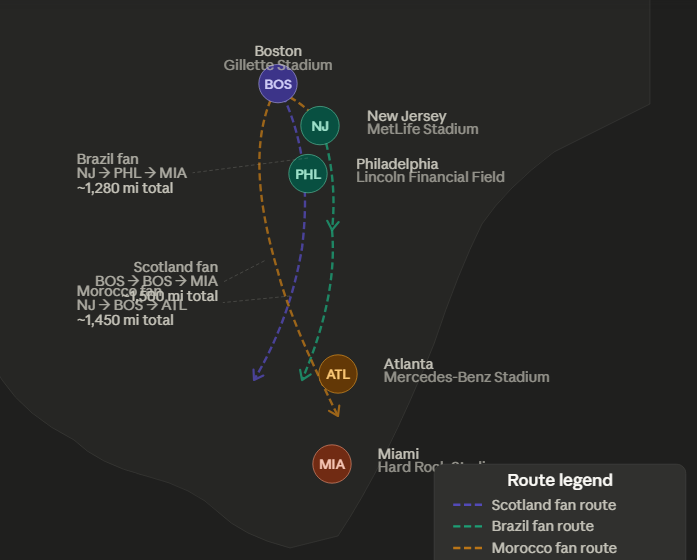
Group C tells the story better than any other. The group contains Brazil, Morocco, Scotland, and Haiti, and its six matches are distributed across five different cities: New Jersey, Boston, Philadelphia, Atlanta, and Miami. No two consecutive group-stage days share a venue.
A Scotland supporter who bought tickets to all three of their team’s matches faces this itinerary: Boston on June 13, Boston again on June 19, then Miami on June 24. That is a comfortable one, Scotland at least has the luck of playing twice in the same stadium.
Brazil fans have it worse: New Jersey on June 13, Philadelphia on June 19, and Miami on June 24, covering around 1,280 miles. But Morocco supporters draw the longest straw in the wrong direction: New Jersey for the opener, then up to Boston, then all the way south to Atlanta.
Approximately 1,450 miles across three legs, requiring minimum two flights, hotel bookings, and the kind of logistical coordination usually reserved for corporate events. This is the direct consequence of FIFA’s decision to spread matches across as many markets as possible.
They maximised broadcast audiences and sponsorship value and the scheduling logic remains commercial but not geographical. Unlike the 1994 World Cup, also in the US, where groups were broadly clustered by region, fixtures are scheduled with little regard for fan travel.
The guide to spectator planning, if you brave the World Cup 2026
The first rule of planning a 2026 World Cup trip is to book flights before tickets, not after. Domestic US airfares for World Cup weekends are already running at two to three times their normal level, and the premium will only grow.
For Group C fans specifically, the Boston-Miami corridor is the one to watch: both cities are expensive in late June under normal circumstances, and a World Cup influx will push hotel rates further.
Anyone following Scotland, Brazil, or Morocco across multiple fixtures should consider positioning themselves in a central hub: Philadelphia sits roughly equidistant from both New Jersey and Boston, making it a viable base for the first two matchdays, before flying south.
For those willing to be flexible about which matches they attend, the relative-value play is to target a single city and watch whatever group games land there, rather than chasing one team across the map.
The 2026 World Cup will be an extraordinary spectacle. But for the fans prepared to travel thousands of miles to see it, the tournament demands as much logistical planning as it does passion.