Opinions & Analysis
Is 2026 becoming the most violent World Cup in history? Eight red cards already dwarf 2022 campaign

Last Updated on 22 June 2026
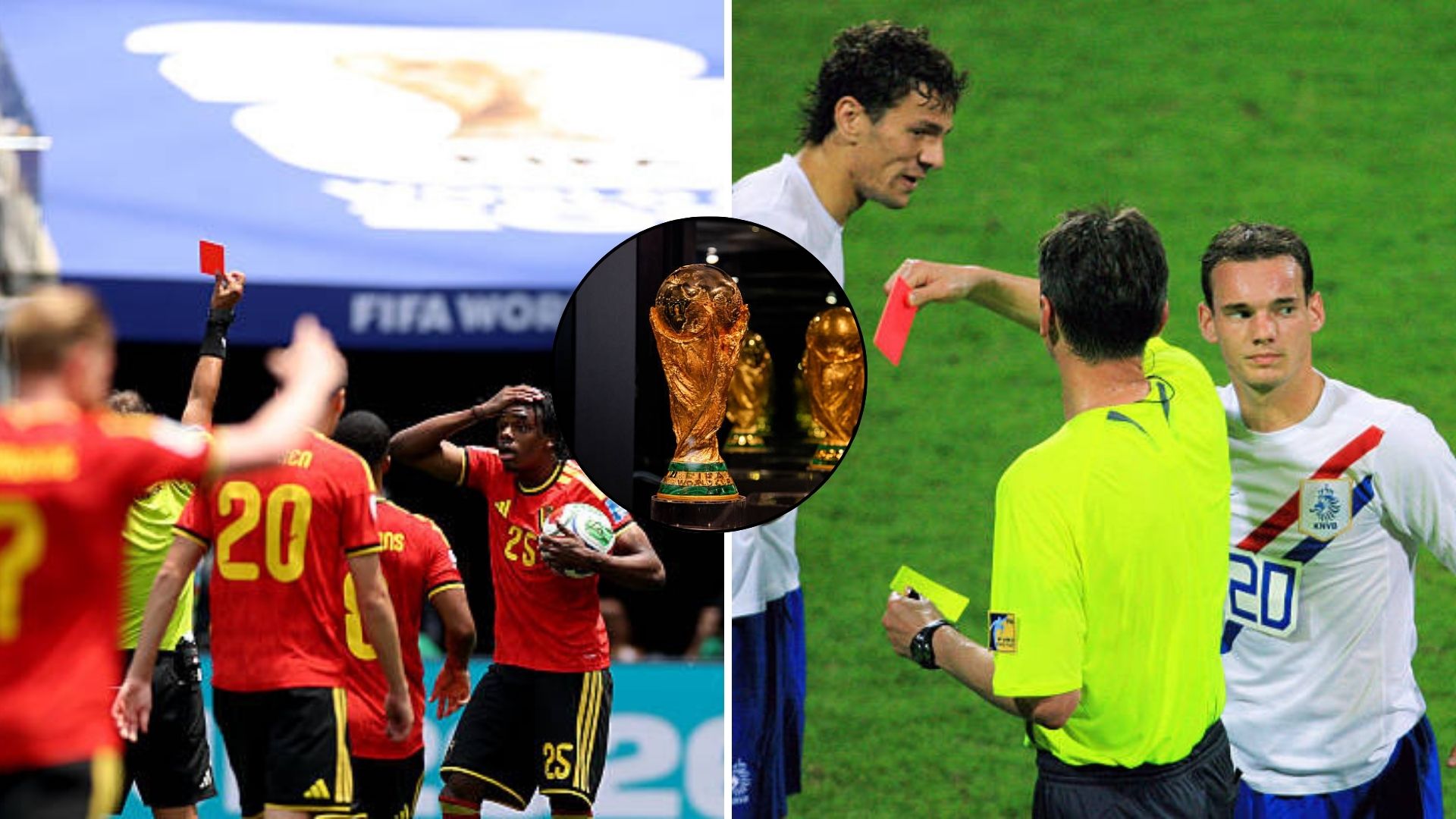
Nathan Ngoy’s straight red card in the 67th minute of Belgium versus Iran on Sunday brought the World Cup 2026’s dismissal total to eight after just 38 matches.
That is more than double the combined total from the entire 2018 and 2022 tournaments. Which is, frankly speaking, absurd.
And with more games still to play than any other World Cup has ever had before in total, the numbers are pointing in one very uncomfortable direction.
Eight red cards, 38 games and the pace is relentless
The dismissals have come quickly and from all directions. The opening match between South Africa and Mexico set the tone with three red cards in a single game: the most in a World Cup fixture since the Battle of Nuremberg in 2006, via FIFA.
Sphephelo Sithole, Themba Zwane and Cesar Montes were all sent off in a chaotic 2-0 contest. From there, the carnage continued. Qatar had two players dismissed against Canada in the same match with Assim Madibo being sent off for breaking Ismael Kone’s leg.
Bosnia and Herzegovina’s Tarik Muharemovic followed, then Paraguay’s Miguel Almiron received the tournament’s first ever dismissal under the new mouth-covering rule after a VAR review determined he directed abuse at a Turkiye player while concealing his lips.
Ngoy’s foul on Taremi completed a set of eight dismissals that reads like a disciplinary case study. The new rules are contributing significantly and the numbers suggest something structural is at play.
The World Cup record books and what history tells us
To understand how significant 2026’s pace is, it helps to map it against previous editions. 2018 and 2022 each produced just four red cards across 64 matches. South Africa 2010 produced 17 dismissals across 64 games, a figure that felt alarming at the time. Brazil 2014 gave us 10.
Germany 2006 remains the benchmark: 28 red cards across 64 matches, with nine of those direct dismissals. The standout moment was the Battle of Nuremberg, the Netherlands versus Portugal Round of 16 match that produced four red cards and 16 yellow cards.
Russian referee Valentin Ivanov showing 16 bookings in a single game, a World Cup record that still stands. Here is where 2026’s trajectory becomes extraordinary. The current rate works out at roughly one dismissal every 4.75 matches.
Across 104 total fixtures, that pace produces almost 22 red cards, and that figure applies only to the group stage, where stakes are lower and panic is already setting in. Knockout football, with its elimination pressure and compressed timelines, inflates the numbers further.
At Germany 2006, the knockout rounds delivered a disproportionate share of those 28 dismissals. Apply the same logic to a 104-game expanded format and the record does not just look vulnerable. It looks beatable. Like some of these.
Whether that is a product of new rules, nervous players or simply the chaos that 48 teams brings to a tournament, the 2026 World Cup has already announced itself as the most ferocious edition in living memory and barely a third of the matches have been played.




