International Teams
World Cup 2026: The heat is on – And Europe might not survive it

Europe’s best arrive in North America carrying trophies, tired legs, and almost no time to adjust. The World Cup 2026 kicks off in conditions that suit the Americas and several of Europe’s heavyweights may pay a heavy price for it.
France face a brutal heat schedule. England, Spain, Portugal and Germany are not far behind. Meanwhile, Brazil, Argentina, Colombia, Ecuador, Mexico, and the United States step onto familiar terrain.
The thermometer could quietly reshape the World Cup before a single knockout ball is kicked.
Europe’s perfect storm: Fatigue, fixtures, and furnace-like conditions
The club season finished later than ever. The Champions League final between PSG and Arsenal took place on May 30 in Budapest: just twelve days before the World Cup opener. Several of Europe’s biggest squads arrived in North America with virtually no recovery window.
France carry the heaviest burden. Bloomberg’s analysis of wet-bulb globe temperatures placed Les Bleus second only to Tunisia for heat exposure across their group-stage schedule. Their fixtures land in New York, Philadelphia, and Boston, cities that bake in June humidity.
Crucially, France’s squad is packed with players from clubs that ran deep into the season. Kylian Mbappe played a full campaign alongside Ibrahima Konate and plenty of other players. The cumulative load on France’s squad is enormous.
England face their own version of this problem. Similarly to Portugal and Spain. Thomas Tuchel has publicly acknowledged the conditions are “not our advantage.” England based themselves in Kansas: warm, but not the most sweltering venue.
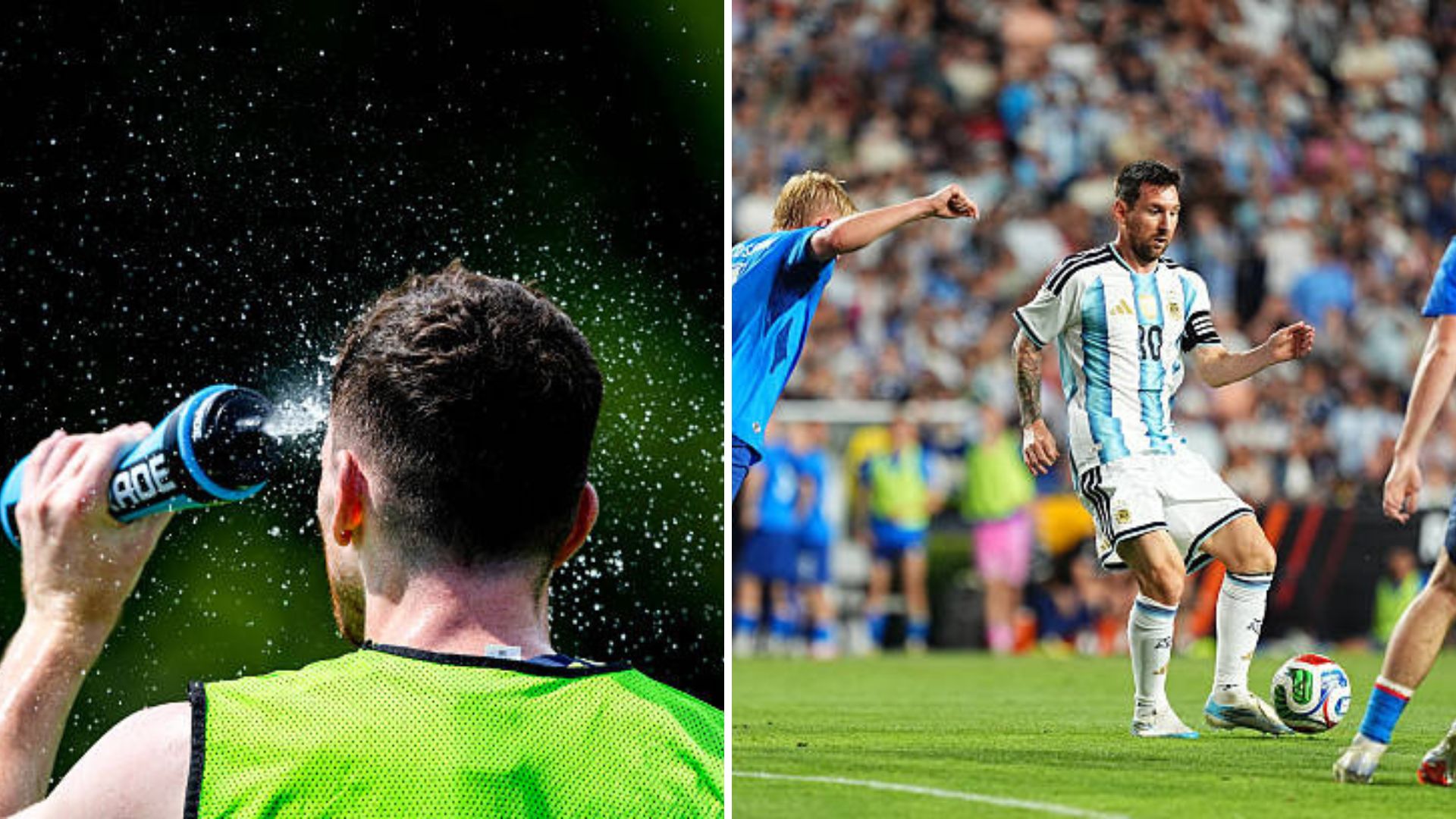
Photographs of European players training went viral, days before the tournament. Several squads were pictured shirtles and dousing themselves with water. Norway went a step further, wearing ice collars around their necks. These are not the images of teams arriving fresh.
The science backs up those concerns. Research into the 2014 Brazil World Cup found measurable performance declines in players once temperatures passed 28°C. Several US host cities, including Miami, Houston, and Dallas, regularly exceed that threshold in June.
Meanwhile, FIFA introduced three-minute hydration breaks per half to address the danger. But they have been exposed for being mainly for advertisement purposes. Many heat experts called that inadequate. And, not to mention the excessive travelling teams have to do.
Why the Americas are already warmed up for the World Cup
The contrast with South America’s major nations is striking. Their players train and compete in heat and humidity routinely. They arrive in North America fresher, more familiar with the physical demands, and, in several cases, at a genuine physical advantage.
Brazil come in with genuine firepower and a point to prove. Argentina, the defending champions, carry Lionel Messi as he chases a second World Cup winners’ medal. Colombia and Ecuador both know these conditions well. Heat is not a shock to their systems.
Experts confirm the edge is real, even if preparation can partially close the gap. “World Cup nations whose players train in hotter climates may have a slight advantage when it comes to adjusting to high temperatures,” physical performance coach Raiyan Abbasi told Al Jazeera.
Then there are the tournament hosts. Mexico and the United States carry an intangible advantage that goes beyond temperature. Crowd noise, familiar geography, and home-soil momentum are real forces in international football. The extended format adds another layer.
With 104 matches and eight games for any team reaching the final, fatigue compounds over 39 days. Mullan’s research found the heat burden builds cumulatively. “That heat loop builds up over time, that fatigue,” he warned. However, None of this means Europe is out.
Spain, the reigning European champions, drew a kinder heat schedule. Germany, England and France, crucially, retain the squad depth to rotate effectively. That combination does not suit a run to the final. It suits a shock exit in the last sixteen. But, on paper, they have better squads.
The sun, the schedule, and the stamina gap have already picked a side. Europeans better hope it is wrong.